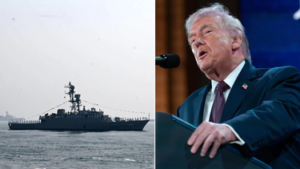










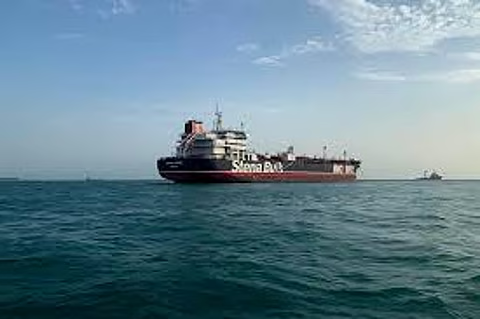
Tensions in the Middle East sharply escalated after Iran targeted and seized multiple vessels — including at least one ship bound for India — just hours after former U.S. President Donald Trump announced an extension of the ongoing ceasefire.
According to international reports, Iranian forces, particularly the Islamic Revolutionary Guard Corps (IRGC), opened fire on and detained ships passing through the strategically critical Strait of Hormuz. Among the vessels affected was one reportedly headed toward Gujarat, highlighting the direct implications for India’s maritime trade routes.
The incident unfolded shortly after Trump declared an indefinite extension of the fragile ceasefire between the United States and Iran, a move intended to provide more time for stalled peace negotiations.
Ships Targeted Amid Rising Suspicion
Iranian authorities claimed the vessels had violated maritime regulations, accusing them of operating without proper authorization, manipulating navigation systems, or ignoring warnings.
However, the attacks have raised serious concerns internationally, with critics arguing that such actions undermine the very ceasefire meant to reduce hostilities. The seizure of vessels also drew condemnation from global shipping authorities and governments, who warned of threats to international maritime security.
A Fragile Ceasefire Under Pressure
Despite the ceasefire extension, the situation on the ground — and at sea — remains volatile. Iran has reportedly refused to rejoin peace talks unless certain conditions are met, including lifting the U.S. naval blockade on its ports.
Meanwhile, the United States has continued its military pressure, maintaining a blockade aimed at restricting Iran’s oil exports. This has further complicated diplomatic efforts and heightened mistrust between the two sides.
Global Impact and Energy Concerns
The Strait of Hormuz, where the incident occurred, is one of the world’s most critical النفط transit routes, handling a significant portion of global oil shipments. Any disruption in this region has immediate ripple effects on global energy markets.
Following the latest developments, oil prices surged past $100 per barrel, raising fears of a broader economic impact and a potential energy crisis.
India Watching Closely
For India, the situation is particularly sensitive. With a large share of its energy imports passing through the Strait of Hormuz, any escalation poses risks to supply chains and economic stability. The involvement of an India-bound vessel has intensified concerns within policymakers and the shipping industry.