










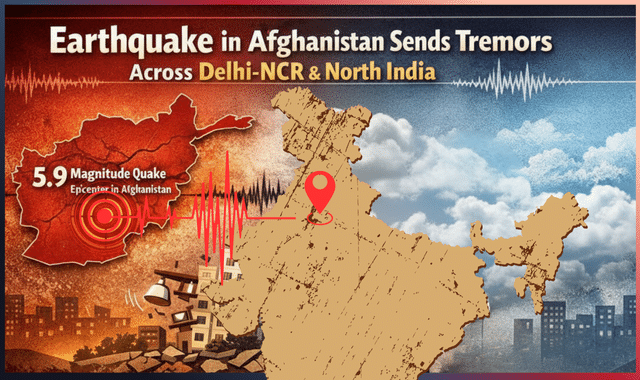
A strong earthquake measuring 5.9 on the Richter scale struck Afghanistan late Friday evening, sending tremors across large parts of North India, including Delhi and the National Capital Region (NCR).
According to officials, the earthquake occurred at around 9:42 PM IST, with its epicentre located near Darawan in Afghanistan. The quake originated at a considerable depth—around 150–170 kilometres beneath the surface—reducing the likelihood of severe damage but allowing the tremors to travel long distances.
Tremors Felt Across North India
Residents in Delhi-NCR reported feeling mild but noticeable tremors that lasted for a few seconds. Many people rushed out of homes and offices as a precaution, while others reported swaying ceiling fans and shaking furniture.
The tremors were not limited to the capital. Several regions across North India—including Punjab, Haryana, Jammu and Kashmir, and even Kargil—also experienced the impact of the quake.
In parts of Kashmir, visuals showed chandeliers and household items moving, reflecting the intensity of the tremors, even at a significant distance from the epicentre.
No Immediate Damage Reported in India
Despite the widespread reach of the tremors, there were no immediate reports of casualties or major property damage in India. Authorities continue to monitor the situation, but initial assessments suggest the impact remained mild in the country.
Experts note that earthquakes occurring deep beneath the Earth’s surface often result in broader but less destructive shaking.
Casualties Reported in Afghanistan
While India escaped major damage, the situation in Afghanistan appears more serious. Early reports indicate that at least eight people may have died due to the earthquake, with some buildings reportedly collapsing in affected areas.
Emergency teams are said to be assessing the damage and carrying out rescue operations in remote regions.
Weather Adds to Anxiety in Delhi
The tremors came on a day when Delhi had already experienced turbulent weather, including dust storms, rain, and strong winds. The sudden shaking added to public anxiety, with many residents initially unsure whether the vibrations were due to weather or seismic activity.
A Seismically Active Region
Afghanistan lies in a highly earthquake-prone zone, particularly around the Hindu Kush region, where tectonic plates frequently interact. Earthquakes originating here are often felt across neighbouring countries, including India and Pakistan.
Friday’s quake is the second instance this year where Delhi-NCR residents felt tremors, following a minor earthquake earlier in January.
Conclusion
Although the earthquake caused panic across North India, the absence of major damage in India comes as a relief. However, the reported casualties in Afghanistan highlight the vulnerability of the region to seismic activity.
Authorities continue to keep a close watch, urging people to remain alert but not panic, as aftershocks—though unlikely to be severe—cannot be ruled out.