










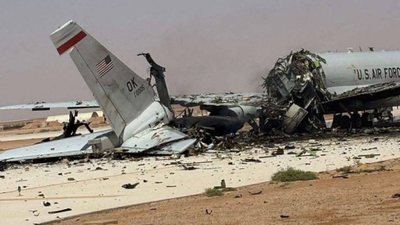
Tensions in the Middle East have escalated sharply after Iran reportedly struck a major U.S. military asset in Saudi Arabia, with emerging images showing the destruction of a highly advanced American surveillance aircraft at Prince Sultan Air Base.
According to multiple reports, an Iranian missile and drone attack targeted the base—located near Riyadh—resulting in severe damage to a U.S. Air Force E-3 Sentry, a critical airborne warning and control system (AWACS) aircraft. The aircraft, often described as a “flying command center,” plays a vital role in monitoring airspace, tracking threats, and coordinating military operations.
Images Reveal Extent of Damage
Visual evidence circulating online appears to confirm the scale of destruction. Photos show the aircraft badly mangled, with parts of the fuselage torn apart—damage so extensive that the jet is believed to be beyond repair.
While Iran has claimed responsibility for the strike, U.S. officials have not fully confirmed the loss publicly. However, defence sources acknowledge that the attack caused significant damage to military assets stationed at the base.
Strategic Blow to US Capabilities
The destruction of an E-3 Sentry is seen as a major setback for the United States. These aircraft are not only expensive—valued at hundreds of millions of dollars—but also rare, with only a limited number still in active service.
Their role goes far beyond surveillance. Equipped with a large rotating radar dome, the aircraft can detect and track enemy aircraft, missiles, and even ground movements over vast distances. In modern warfare, they act as airborne command hubs, directing fighter jets and coordinating responses in real time.
Losing even one such platform could weaken situational awareness and operational coordination in a region already on edge.
Casualties and Wider Damage
The strike did not only affect equipment. Reports indicate that at least 10 to 12 U.S. personnel were injured, some seriously, during the attack.
In addition to the destroyed surveillance aircraft, other assets—including refuelling planes—were also damaged, highlighting the scale and precision of the assault.
Part of a Larger Conflict
This incident is part of a broader and intensifying conflict between Iran and U.S.-aligned forces in the region. Since late February, Iranian missile and drone strikes have repeatedly targeted American positions and allied infrastructure across the Middle East.
Analysts say the focus on high-value targets like AWACS aircraft suggests a deliberate strategy to degrade U.S. airpower and surveillance capabilities.
Rising Global Concern
The attack has raised alarms internationally, with fears that continued escalation could draw more countries into the conflict. There are also growing concerns about the security of key military bases and energy infrastructure in the Gulf region.
As both sides continue to exchange threats and military actions, the destruction of the E-3 Sentry marks a significant and symbolic moment—one that underscores how rapidly the situation is deteriorating.