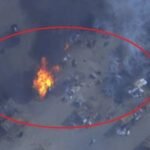






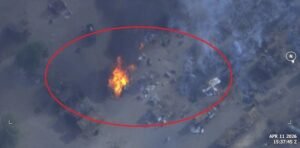


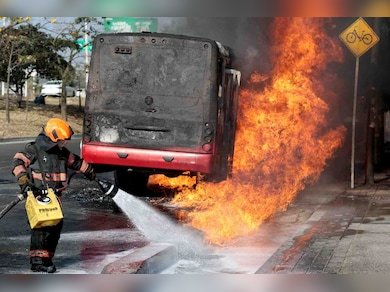
Mexico City, Feb 23, 2026 — A wave of violence and chaos swept across parts of Mexico after security forces killed Nemesio Rubén Oseguera Cervantes, widely known as “El Mencho”, the feared leader of the Jalisco New Generation Cartel (CJNG). His death — hailed as a major victory in Mexico’s fight against organised crime — unleashed immediate and dramatic retaliation from cartel members, leaving highways blocked, vehicles and businesses ablaze, and communities on edge.
El Mencho, long one of the most wanted figures in global organised crime, was killed by the Mexican army during a raid in the western state of Jalisco on Sunday, according to government sources. The operation, carried out with intelligence support from the United States, was intended to capture the cartel boss but ended with him wounded and later pronounced dead.
Cartel Backlash: Fires, Roadblocks, and Fear
Within hours of the announcement, CJNG loyalists launched a coordinated campaign of destruction across multiple states — including Jalisco, Guanajuato, Colima, and Aguascalientes. Armed groups blocked major highways by burning cars and trucks, while supermarkets, petrol stations, banks and other businesses were torched in symbolic acts of retaliation. Photographs and video shared on social media showed smoke rising over cities as residents were urged to stay indoors.
In the city of Guadalajara, videos captured thick plumes of smoke rising from burning vehicles, while in Puerto Vallarta, a popular coastal resort, tourists watched from hotel balconies as smoke darkened the skyline. Major airlines, including Air Canada, United Airlines and Aeroméxico, temporarily suspended flights due to the unrest.
Authorities reported incidents of gunfire, roadblocks and armed groups operating in residential areas, prompting curfews and warnings from both Mexican officials and foreign governments. The U.S. Embassy issued shelter-in-place advisories for American citizens in affected states.
A Symbolic Blow With Complex Consequences
El Mencho’s death was seen by Mexican authorities and international partners as a significant achievement in efforts to weaken cartel operations that have fueled violence and drug trafficking for years. The CJNG, notorious for its military-style tactics and control over vast territories, has been a priority target due to its role in trafficking fentanyl, cocaine, heroin and methamphetamine.
Yet analysts warn the move could also trigger unpredictable consequences. As cartel factions scramble to fill the leadership vacuum, internal power struggles may intensify and spur further violence. Within CJNG ranks, competing groups have already begun maneuvering for dominance, raising fears of an extended period of instability.
President Claudia Sheinbaum acknowledged the volatile situation but urged calm, saying most of the country remained stable and that authorities were working to reestablish order. Meanwhile, security forces have increased patrols and checkpoints in key areas to prevent further attacks.
Lives Interrupted and Business Disrupted
For many ordinary Mexicans, the violence has upended daily life. Schools were closed in several cities, and trucks were warned to avoid major highways. In smaller towns, residents described an atmosphere of fear and uncertainty as armed groups asserted control of certain streets.
Though no confirmed civilian death toll has been released, the destruction of property and disruption to travel has sparked deep concern among locals and officials alike. Officials say ongoing operations are focused on containing the violence and preventing further loss of life.