





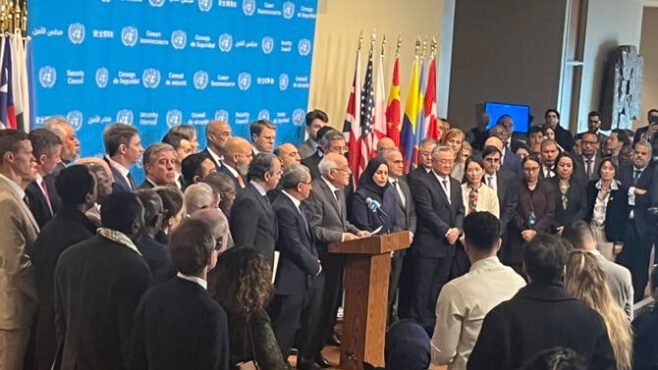
UNITED NATIONS, New York — Tensions flared at the United Nations Headquarters this week as the Permanent Observer of the State of Palestine, Riyad Mansour, led a coalition of over 80 member states in a blistering condemnation of what they termed a “mega land grab” by Israeli authorities in the occupied West Bank.
Speaking to reporters on Tuesday, February 17, Mansour delivered a joint statement on behalf of the Arab Group and dozens of international organizations, calling for the immediate reversal of new Israeli security cabinet decisions that diplomats warn could effectively cement permanent Israeli control over vast swathes of Palestinian territory.
The controversy centers on a quiet but sweeping policy shift: the resumption of land registration procedures in “Area C” of the West Bank—a process that had been frozen since 1968.
“We strongly condemn unilateral Israeli decisions and measures aimed at expanding Israel’s unlawful presence in the West Bank,” Mansour said, flanked by ambassadors from a diverse coalition including members of the Organization of Islamic Cooperation and the Non-Aligned Movement.
“Such decisions are contrary to Israel’s obligations under international law and must be immediately reversed. We underline in this regard our strong opposition to any form of annexation.”
A “Legal” Mechanism for Expansion
The heart of the dispute lies in the technical but consequential details of land law. By resuming registration in Area C—which constitutes about 60% of the West Bank—Israeli authorities can now require Palestinians to provide proof of ownership that meets strict Israeli legal standards. Landowners unable to produce such documentation risk having their property automatically designated as “state land,” opening it up for potential settlement development.
Critics, including legal advocacy group Adalah, argue this is a bureaucratic engine for dispossession. They note that the move, combined with new measures extending Israeli enforcement authority into Areas A and B (zones previously under Palestinian civil control), amounts to “de facto annexation” of the territory.
“We reiterate our rejection of all measures aimed at altering the demographic composition, character, and status of the Palestinian Territory occupied since 1967,” Mansour told the press stakeout. He warned that these actions “jeopardize the prospect of reaching a peace agreement ending the conflict.”
International Fallout
The diplomatic shockwaves have reached the highest levels of the UN. Secretary-General António Guterres issued a statement expressing “grave concern,” noting that the moves threaten to sever the contiguous land needed for a future Palestinian state.
The timing is particularly sensitive. The briefing comes just days before the high-stakes “Board of Peace” meeting scheduled for February 19 in Washington, D.C., where global leaders are expected to discuss the implementation of a new comprehensive peace plan.
Diplomats privately fear that the situation on the ground in the West Bank is deteriorating so rapidly that it may render the upcoming talks moot. “You cannot negotiate the division of a pie while one side is actively eating it,” remarked one European diplomat who attended the briefing.
As the international community pivots its eyes to Washington, the message from the UN stakeout was clear: for 80 nations, the two-state solution is on life support, and these latest decisions may be pulling the plug.