









At least five people have been killed and hundreds of thousands displaced as rains driven by Typhoon Kalmaegi flooded swathes of the central Philippines on Tuesday (November 4, 2025).
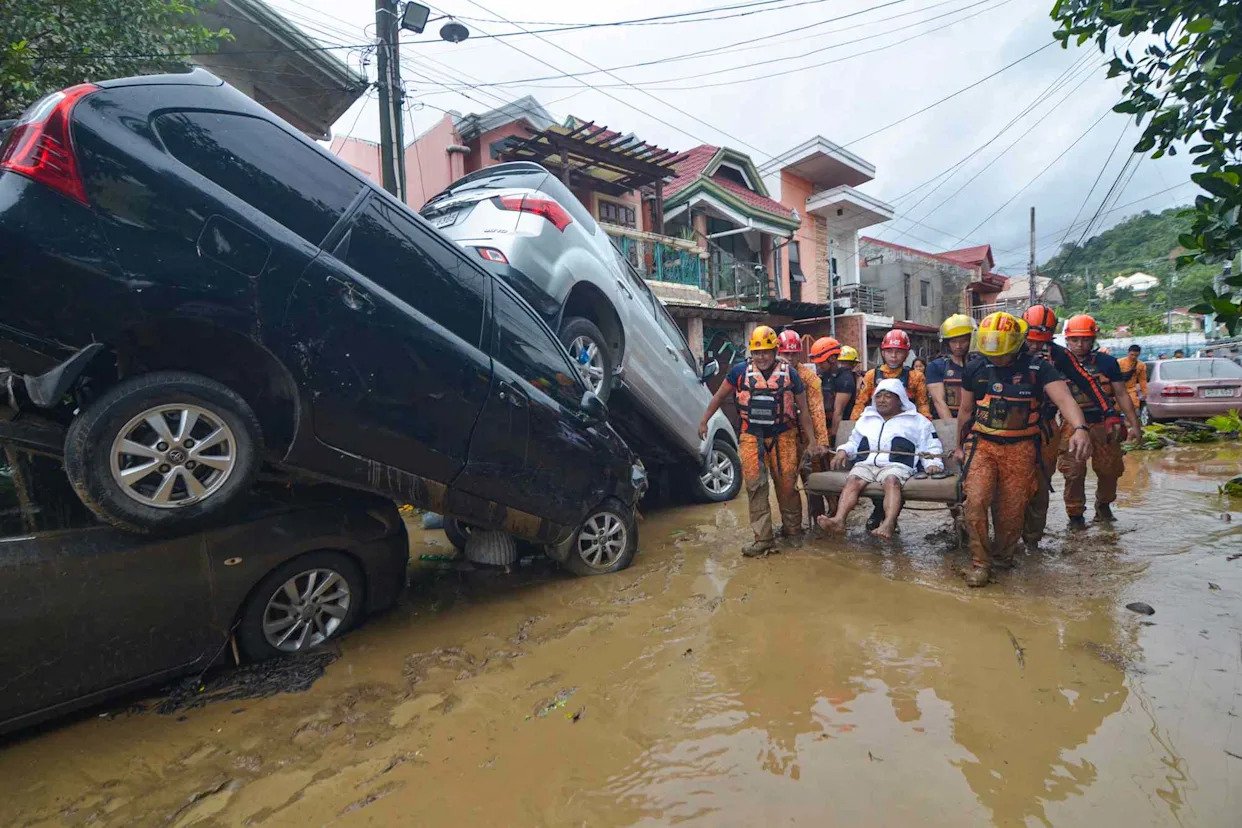
Entire towns on the island of Cebu have been inundated, while cars, trucks and even massive shipping containers could be seen swept along by muddy floodwaters in videos verified by AFP.
In the 24 hours before Kalmaegi’s landfall, the area around provincial capital Cebu City was deluged with 183 millimeters (seven inches) of rain, well over its 131-millimetre monthly average, state weather specialist Charmagne Varilla said.
Typhoon Kalmaegi intensified as it made landfall in the central Philippines on Tuesday (November 4, 2025), after slamming ashore overnight from the Pacific, setting off flash floods that trapped residents on roofs and submerged cars in two villages, and displacing tens of thousands of people, officials said. The state weather bureau warning of “life-threatening” conditions as it placed large parts of the Visayas region under the second-highest storm warning.
Kalmaegi, the 20th tropical cyclone to batter the Philippines this year, was moving westward at 25 kmph (16 mph) and was forecast to start shifting away from the western section of the archipelago into the South China Sea later Tuesday (November 4) or early Wednesday (November 5), forecasters said.
Death toll at five
“The situation in Cebu is really unprecedented,” provincial governor Pamela Baricuatro said in a Tuesday (November 4) Facebook post. “We were expecting the winds to be the dangerous part, but… the water is what’s truly putting our people at risk,” she said. “The floodwaters are just devastating.”
Local disaster official Ethel Minoza told AFP the bodies of two children had been recovered in Cebu City, where rescuers were still attempting to reach residents trapped by floodwaters.
At least three other deaths have been confirmed elsewhere, including an elderly resident who drowned in an upper floor of their home in Leyte province and a man struck by a falling tree in Bohol.
Floodwater causing damage
An elderly villager drowned in floodwaters in Southern Leyte, where a provincewide power outage was also reported, and another villager died after being hit by a fallen tree in central Bohol province, officials said in initial reports without providing other details.
Gwendolyn Pang, secretary-general of the Philippine Red Cross, said an unspecified number of residents were trapped on their roofs by floodwaters in the coastal town of Liloan in central Cebu province. In the city of Mandaue, also in Cebu, floodwaters were “up to the level of heads of people,” she said, adding that several cars either were submerged in floods or floated in another Cebu community.
“We have received so many calls from people asking us to rescue them from roofs and from their houses, but it’s impossible,” Ms. Pang told The Associated Press. “There are so many debris, you see cars floating so we have to wait for the flood to subside.”
In Eastern Samar, one of the east-central provinces first lashed by Kalmaegi early Tuesday (November 4), fierce wind either ripped off roofs or damaged about 300 mostly rural shanties on the island community of Homonhon, which is part of the town of Guiuan, but there were no reported deaths or injuries, Mayor Annaliza Gonzales Kwan said.
“There was no flooding at all, but just strong wind,” Ms. Kwan told the AP by telephone. “We’re Ok. We’ll make this through. We’ve been through a lot, and bigger than this.”
In November 2013, Typhoon Haiyan, one of the most powerful tropical cyclones on record, slammed ashore into Guiuan then raked across the central Philippines, leaving more than 7,300 people dead or missing, flattening entire villages and sweeping scores of ships inland. Haiyan demolished about a million houses and displaced more than 4 million people in one of the country’s poorest regions.
Ahead of the typhoon’s landfall, disaster-response officials said more than 150,000 people had evacuated to safer ground in eastern Philippine provinces. Authorities warned of torrential rains, potentially destructive winds and storm surges of up to 3 meters (nearly 10 feet).
The typhoon, which has a broad wind band spanning about 600 kilometers (373 miles), was expected to batter central island provinces, including Cebu, which is still recovering from a 6.9-magnitude earthquake on Sept. 30 that left at least 79 people dead and displaced thousands when houses collapsed or were severely damaged.
On central Negros island, villagers were warned that heavy rains could cause volcanic mudflows on Mount Kanlaon, one of the country’s 24 most active volcanoes which has been emitting plumes of ash and steam in recent months, according to the Philippine Institute of Volcanology and Seismology.
Interisland ferries and fishing boats were prohibited from venturing into increasingly rough seas, stranding more than 3,500 passengers and cargo truck drivers in nearly 100 seaports, the coast guard said. At least 186 domestic flights were canceled.
The Philippines is battered by about 20 typhoons and storms each year. It is often hit by earthquakes and has more than a dozen active volcanoes, making it one of the world’s most disaster-prone countries.