









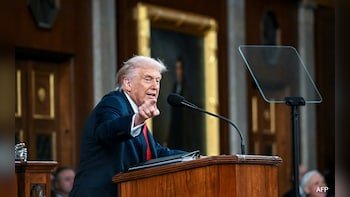
Washington, D.C. — In a forceful address to lawmakers on Tuesday night, U.S. President Donald Trump defended his controversial trade policies and doubled down on a claim that high tariffs on foreign goods could one day replace the federal income tax system — a proposal experts say is misleading and economically impractical.
Speaking before a joint session of Congress in the annual State of the Union address, Trump portrayed his tariff strategy as a cornerstone of America’s economic resurgence, arguing it has brought in billions of dollars for the government while easing the tax burden on ordinary Americans.
“As time goes by, I believe that tariffs paid by foreign countries, like in the past, will substantially replace the modern-day system of income tax, taking a great financial burden off the people that I love,” Trump said, emphasizing his belief that other nations are now paying into the U.S. Treasury rather than exploiting the American economy.
However, Trump’s remarks came just days after the U.S. Supreme Court dealt a significant blow to his tariff program, ruling that much of his broad tariff authority overstepped the executive branch’s legal powers. Trump called the decision “very unfortunate,” even as he touted new tariff measures under alternative legal authority.
Supreme Court setback and Trump’s response
Last week, the Supreme Court struck down key parts of Trump’s sweeping global tariff regime, finding that the president exceeded his authority under emergency powers when imposing tariffs on a wide range of imports. The 6-3 ruling affirmed that Congress — not the White House alone — holds primary authority to levy such taxes.
In response, Trump moved quickly to introduce revised tariffs, including a 10–15% global levy on imports under long-established trade law, aiming to preserve his trade agenda despite the court defeat.
Trump attacked the court’s decision during his speech and expressed confidence that many countries would continue to honor previously negotiated trade arrangements, warning that future deals could be “far worse” for foreign partners if negotiations faltered.
Economic reality and expert skepticism
Economists and tax analysts have been quick to challenge Trump’s assertion that tariffs could supplant the income tax system. Data from U.S. Treasury reports shows that income tax — especially personal income tax — accounts for a large majority of federal revenue, while tariffs make up a small fraction. Experts say tariffs cannot realistically generate enough revenue to replace the income tax, and that most of the economic burden of tariffs ultimately falls on American businesses and consumers, not foreign governments.
“A tariff-only system would require exorbitantly high rates that would shrink imports and could harm the broader economy,” one economic analyst recently told reporters.
Political backdrop
Trump delivered his address with much of the nation watching closely, including on social media, where reactions ranged from support for his trade stance to sharp criticism that his tariff claims were disconnected from economic reality.
The State of the Union also offered Trump a platform to highlight other priorities — from immigration and national security to healthcare and manufacturing — even as the tariff issue remains a central and contentious part of his policy agenda.