
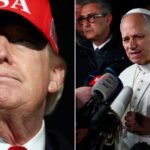

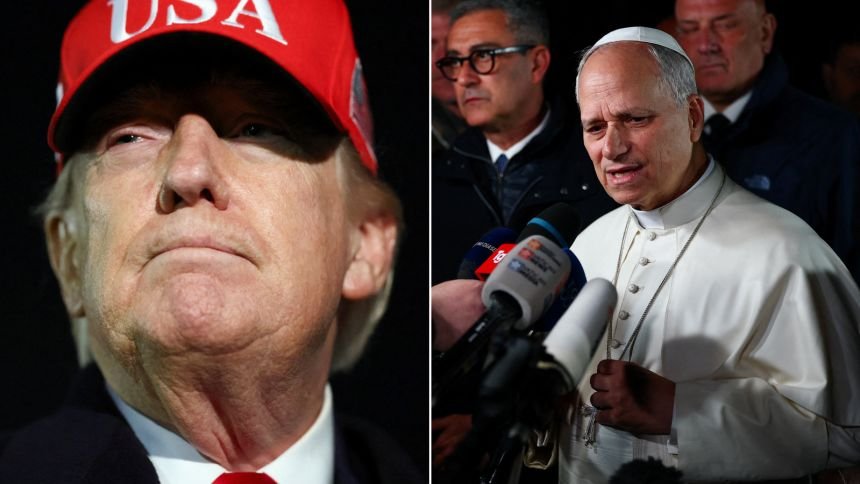
In a rare and striking confrontation between political and religious leadership, U.S. President Donald Trump has launched a sharp public attack on Pope Leo XIV, deepening tensions over global conflict and moral leadership.
The dispute follows a series of remarks by Pope Leo condemning the ongoing U.S.-aligned military conflict involving Iran and calling for peace. In response, Trump took to social media to criticize the pontiff, describing him as “weak on crime” and “terrible for foreign policy,” while also accusing him of aligning with left-leaning political views.
Speaking to reporters shortly after his post, Trump doubled down on his criticism, stating he was “not a big fan” of the first American-born pope and suggesting that Leo should focus more on spiritual leadership rather than political commentary.
Pope’s Calls for Peace Spark Political Backlash
Pope Leo XIV, who became the first U.S.-born leader of the Catholic Church in 2025, has recently emerged as a vocal critic of the escalating conflict in the Middle East. In public addresses, he warned against what he described as a “delusion of omnipotence” among world leaders and stressed that war cannot be justified in the name of religion.
He also directly criticized threats made against Iran, calling them “unacceptable,” and urged global leaders to pursue diplomacy and restraint instead of military escalation.
Beyond foreign policy, the pope has raised concerns about immigration policies in the United States, advocating for compassion and dignity toward migrants—positions that have increasingly put him at odds with the Trump administration.
A Rare Public Feud
While disagreements between U.S. presidents and the Vatican are not unprecedented, the tone and directness of this exchange are highly unusual. Analysts note that it is rare for a pope to so openly criticize a sitting U.S. president—and equally uncommon for a president to respond with such personal and public attacks.
The clash reflects broader ideological differences: Trump’s emphasis on national security and assertive foreign policy contrasts sharply with the Vatican’s focus on peace, humanitarian concerns, and moral restraint.
The tensions have also played out symbolically. Shortly after his remarks, Trump shared controversial imagery on social media portraying himself in a religious context, further fueling debate about the intersection of politics, religion, and public messaging.
Wider Implications
The dispute comes at a time of heightened global instability and raises questions about the influence of religious voices in political debates. Pope Leo’s criticism has resonated with those advocating for de-escalation, while Trump’s response underscores the administration’s firm stance on national security and geopolitical strategy.
As the pope prepares for an international tour and the U.S. continues its involvement abroad, observers say the divide between Washington and the Vatican could shape both diplomatic discourse and public opinion in the months ahead.