









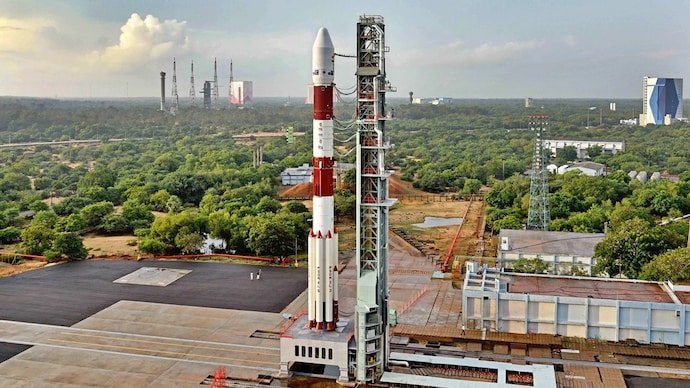
The historic Satish Dhawan Space Centre in Sriharikota is buzzing with activity as the Indian Space Research Organisation (Isro) prepares for its first major orbital feat of 2026. Scheduled for lift-off today, the PSLV-C62 mission is not just another routine launch; it is a high-stakes celestial ballet.
Carrying 16 satellites into a Sun-Synchronous Polar Orbit, Isro’s “workhorse” is set to demonstrate India’s growing dominance in the global small-satellite launch market.
The launch is scheduled to take place from the First Launch Pad in Satish Dhawan Space Centre at 10:17 am IST.
THE PRIMARY PASSENGER
At the heart of this mission lies the EOS-N1, an advanced Earth Observation Satellite developed by the Defence Research and Development Organisation (DRDO). Dubbed Anvesha, the satellite is equipped with sophisticated hyperspectral imaging technology.
It captures super-detailed pictures that display not just primary colours, but hundreds of narrow, continuous light bands for every pixel, creating a unique spectral fingerprint for each material. This allows scientists to “see” chemical signatures, from monitoring crop health and soil moisture to detecting mineral deposits and tracking urban sprawl with high-resolution data.
ON-ORBIT REFUELLING
A revolutionary aspect of this mission is AayulSAT, developed by the Bengaluru-based startup OrbitAID Aerospace. This satellite acts as a technology demonstrator for India’s first on-orbit refuelling model.
Traditionally, a satellite’s lifespan is limited by its fuel; once the propellant runs out, the asset becomes space debris. AayulSAT aims to change this by testing a proprietary docking interface and a fuel-transfer mechanism in microgravity, laying the groundwork for “orbital petrol pumps” to extend the life of global constellations.
SPACE CYBERCAFE VIA INDIA’S FIRST AI-IMAGE LAB
In a bold leap, this mission carries the MOI-1 satellite, a collaborative effort by Hyderabad-based startups TakeMe2Space and Eon Space Labs. This mission debuts India’s first orbital AI-image laboratory.
MOI-1 processes data directly on the satellite using edge computing, slashing latency for lightning-fast analysis. By enabling the world’s first cybercafe in space, the mission allows users to rent time on the processor for $2 (Rs 180) per minute, effectively democratising access to orbital intelligence.
Tucked inside the MOI-1 satellite is another record-breaking marvel: MIRA, the world’s lightest space telescope.
Developed by Eon Space Labs, this 502-gram optical system is carved from a single, solid block of fused silica glass. By integrating the telescope directly into the MOI-1 AI laboratory, the team has created a seamless eye and brain unit in orbit.
MIRA’s single-piece construction makes it virtually indestructible, ensuring it stays perfectly in focus despite the violent vibrations of launch.
A GLOBAL RIDESHARE: FROM NEPAL TO BRAZIL
Isro’s commercial arm, NewSpace India Limited, has transformed this flight into an international “satellite taxi.”
The manifest includes Munal from Nepal, supported by India’s Ministry of External Affairs, which will map the nation’s topography.
From Spain, the 25-kg Kestrel Initial Demonstrator (KID) capsule will test atmospheric re-entry technology, intentionally plunging into the South Pacific Ocean after two hours.
The mission also features the Indo-Mauritius Joint Satellite and a Brazilian cluster including Aldebaran-1 for maritime rescue and the “Orbital Temple,” which will store 14,000 names perpetually in the void.
Domestically, Dhruva Space is launching a suite of satellites including LACHIT and Thybolt-3 to validate indigenous communication subsystems.
As the roar of the PSLV engines echoes across the Bay of Bengal today, India reinforces its status as a reliable gateway to space. The heavens are waiting, and Isro is ready to deliver.